Flying CJ6. Yak 52, B-25J and of course "Super Flea"
Tuesday, January 13, 2009
Friday, August 31, 2007
Tuesday, February 27, 2007
Ice Runway

Winters in New England are cold. Of course this revelation should be of no surprise to anyone, especially to someone who has lived his entire life in Main e Maine
I plug in my err…um…heat gun, point it at the sump, throw the switch to high and…nothing? I check the built in ground fault…nothing? No power at all. A few choice words and as I rush around to the front of the plane to check the… You guessed it. The engine is still ice cold, the heater isn’t even running!
I turn west and a check of the GPS confirms that we are bucking a bit of a headwind. 110 mph indicated airspeed and 80 mph over the ground. This time I’m actually pleased to have the head wind. Our destination is just a few miles away and it doesn’t seem right to start the engine on a cold winter day, only to shut it down 15-20 minutes later.

 I drop thirty degrees of flaps and pull power to idle. I skid a little to right of center line as I notice that this year the runway has a curve in it. I touch down just a little faster than I had planned but with enough runway, staying off the breaks I pull the yoke back to keep the nose wheel off for as long as possible taking advantage of the aerodynamic breaking, and dancing on the rudder to maintain alignment.
I’ve flown into
 slickest I’ve ever seen it. Normally there is some texture to the ice and a little packed snow here and there to give you some control. This year the ice is pure, smooth, clear and dark. I could gain absolutely no traction at all. The wheels never even turned on touch down they just slid. It was like being on water. Nose wheel steering and differential breaking were useless.
 I pass by the midfield turn offs. I’ll be letting her ease to a stop, rolling (or was it sliding?) out to the end of the runway.
Reaching the end of the runway, a burst of power across the rudder slides her around and onto the taxiway. I taxi slower than I ever remember taxing. There is a very slight breeze, only about three or four miles an hour but it is enough to push the plane sideways, turning the nose wheel does nothing.
I reach the ramp and the gang from the Cessna 150 – 152 Club has already gathered and are coming over to help me park. I would later find out that my approach to landing had been photographed. Super Flea and Steve’s photographic skills made me look good this time and there is no mention of my scrape with the Skyhawk or my go around.

After a warm welcome from my fellow Cessna drivers, we all walk up to the local restaurant for a hearty lunch and to exchange some war stories. One of the greatest things about flying airplanes is the people you meet. Here I sit with a group of ten to twelve other pilots from all over the North East, some flying for several hours, just for a chance to land on the ice and meet other Cessna 150 pilots for lunch. Some of them I’ve met before and some I’ve only corresponded with via email. I’ve earned friends from all walks of life, from across the nation and even around the world and all I’ve done is buy and airplane and joined an owners club. We need know nothing more about each other than our mutually shared love of flight. Anyone who owns and flies a Cessna 150 must be a good guy after all. As good spirited, reliable and unassuming as the steed they choose to fly.
 life, from across the nation and even around the world and all I’ve done is buy and airplane and joined an owners club. We need know nothing more about each other than our mutually shared love of flight. Anyone who owns and flies a Cessna 150 must be a good guy after all. As good spirited, reliable and unassuming as the steed they choose to fly.
These guys and gals are the heart and soul of general aviation and I’m honored to know them, and count them among my friends.

After lunch I walk alone out to “the flea” for a preflight check. Along the way I run into some friends I know through work. Richard and his wife Anna live just up the road and had come down to see all the airplanes and have a bite to eat at the restaurant. We talk as a J-3 cub makes its approach to land. Hanging in the air more like a hot air balloon than an airplane it slips in for a landing. God, I love Cubs!

I watch as one by one the Cessnas depart. Then it is our turn. Preflight complete, engine warmed at idle we do a quick mag check as we slide our way toward the runway.
Lining up close to the right side of the runway because of the bend, I apply power slowly waiting for the rudder to become effective before applying full power. Torque and P-factor can send you off into a snow bank if you’re not careful on the ice.
At 65 mph we rotate and start a shallow climb. Turn left to follow the shoreline and we stay low contour flying around the lake. When contour flying, you really get a sensation of speed that you don’t up at altitude. Even a modest airplane like the Cessna 150 seems like it is hurling around the curves, a sensation that is amplified by the nimble little 150s responsive controls.
Rounding the mountain side I pull us up into a climb and trade our speed for altitude. I turn back toward Sanford Sanford Airport
Here are a couple videos that were posted on Youtube for you to see what it is like to land at Alton Bay:

Thursday, November 30, 2006
Dreams Do Come True!

I wrote the following article for the 500th bomb Squadron Association "The Rough Raiders'" news letter:
Weather checked as being better than five thousand and five, as we start our pre-flight inspection of our ship. The B-25 sits quietly as we pull the props through six blades a side, pausing briefly as some oil is pressed out of the lower cylinders of “Tondelayo’s” #1 engine. We are running late this morning, and tell our crew to load up as we rush through the walk around inspection, anxious to get into the air. “Tondelayo” has other plans this morning however, and my co-pilot discovers a loose exauhst manifold on #2 engine. We’ll be taking another delay while our maintenance crew locks it down.


My grandfather died while I was very young but I have always shared his love of Aviation. Less than perfect eyesight kept me from a military flying career, but I graduated from Daniel Webster College in Nashua NH with two degrees in Aviation Management and Flight Operations. I obtained my pilot’s license and went to work in the field of Airport Management.
More importantly I would see to it that when I flew the B-25 my grandmother, Jean Burbank would fly along with me. I wanted her to see me close the loop that my grandfather had started, to see her grandson at the controls of the B-25.
With the help of a few co-workers I contacted the Collings Foundation and told them my story. My hope was to get my grandmother and myself onboard for a flight, and maybe, just maybe they would let me fly right seat while my grandmother looked on! Kevin Miles of the Collings Foundation told me that they were coming to my airport in a couple weeks and if we could get ourselves down to Beverly, he could get the two of us on the plane, but he couldn’t promise any “stick time.”

 Raider B-25J from Beverly, Massachusetts, to Portsmouth, NH. With him on the flight, manning the left waist gun position was his grandmother, Jean Partridge Burbank. Clutched in her carry case was precious cargo, The Army Air Corps Wings and Air Medal awarded to her husband. Also present to see us off, was my mother Diane Burbank Pomeroy, daughter of Jean and Orie.
 us for as long as we both shall live. I know my grandfather was right there with us the whole time. I had no worries, as I knew he was covering our six!
Saturday, April 23, 2005
Construction Season at PSM
What follows is a short article that I wrote for the local Air Traffic Control Tower news letter entitled "View from the Piscatiqua"
Airport Construction Season is Here!
Here in New England we talk a lot about our change of seasons. We are lucky to have four distinct seasons, each with its own special character. It is not hard to find beauty in each of our four seasons, but sometimes one can over stay its welcome. Winter has finally picked up and moved to its summer home south of the equator, and spring has joined us for a few months, promising warmer weather, green leaves, spring flowers and of course some excellent flying weather. The world seems to be coming to life all around us, and we look to the months ahead with excitement and anticipation. Change is good.
New England airports have two “seasons:” snow season, and construction season. During an airport’s snow season; as in nature, growth comes to a stand still. The airport staff is constantly doing battle with Mother Nature. All the airport’s resources are dedicated to that task. When they are not battling the winter storms, the airport staff is cleaning up from the last battle and preparing for the next.
With the coming of spring and “construction season” the focus shifts to repairing the damage done during our skirmishes with Mother Nature, and the ravages of time. We too look to the months ahead with excitement and anticipation, for now all the airport resources can be directed toward progress and growth. Yes things are coming to life here at Pease Airport as well.
Our airport is in the middle of a transition period in its life, sort of a midlife crisis if you will. Our proud Cold War veteran has worn the uniform of the Strategic Air Command for more than fifty years. Over those fifty plus years it has seen many changes and developed a few health problems.
Pease has developed a sort of cancer in its vast concrete aprons. We call this concrete “cancer” Alkali Silica Reaction, or ASR for short. This cancer causes the concrete to swell and degrade rapidly. Thankfully this cancer was diagnosed in time and is treatable. It must first be isolated and then removed entirely.
We first started treating our airport’s health problem by isolating this cancer. Cutting relief strips, or expansion joints in the concrete. These are the asphalt strips you can see cutting our vast concrete apron into sections.
This year we are continuing this process by removing a few rows of concrete along the east side of Taxiway Alpha, in what is referred to as the Taxiway Object Free Area. This will necessitate several taxiway closures and some creative detours to keep traffic flowing during the construction project.
Please check your NOTAMs frequently and remain on centerline when traveling around construction areas. These areas can be confusing at times but that little “yellow brick road,” we call taxiway centerline, will always keep you out of trouble. There will also be green centerline reflectors and blue reflective flex-stakes along taxiway edges to help guide you along your way.
While we are addressing the airport’s “health problems” we will also be helping the airport with the other part of its midlife crisis, its transition into civilian life. When Pease airport was built it was designed to be simple and efficient. One long runway next to one huge concrete apron, very simple. Pease was perfectly designed for its military life; clean, disciplined, no frills, no coloring outside the lines. Everyone at the airport knew exactly where they had to be and when they had to be there. Pease had one mission, the defense of her nation in uncertain times and everyone who used the airport was there to support that common mission.
Civilian life is a little more complicated. The airport must now fit several different missions simultaneously. Airlines, air cargo, corporate jets, and private aircraft must all coexist, with their military neighbors; Pease is and shall remain a proud citizen soldier. No two airport users have the same mission or goal in mind when they come to Pease. Their missions are as varied as the aircraft they fly and yet they must all be able to reach their destinations quickly and efficiently. To this end Pease must be re-engineered and compartmentalized.
As we remove and replace the concrete in Taxiway Alpha’s East Object Free Area, we will be installing new taxiways, complete with taxiway lighting and signs. These new taxiways will be separated by grass islands. This will serve two purposes. First it will isolate Taxiway A from the concrete apron, helping to stop the cancerous spread of ASR. Second it will provide better guidance for pilots as they arrive and aid them in finding their way to their intended destination. Pilots will be greeted by a more familiar taxiway layout instead of the current sea of concrete. Taxi instructions will be easier to give and more easily understood. A pilot need only tell the ground controller his destination and will be directed to a specific taxiway that will take them direct to their destination.
These changes will not only extend the life of our airport but also make Pease a more user-friendly airport. Change is good.
The airport is also now holding Quarterly Airport Users’ Group Meetings, which are open to all Pease Airport Users. The next meeting will be held on Wednesday, June 22, 2005 at 1830 at Southern New Hampshire University on Corporate Drive. I look forward to seeing you all there.
Here in New England we talk a lot about our change of seasons. We are lucky to have four distinct seasons, each with its own special character. It is not hard to find beauty in each of our four seasons, but sometimes one can over stay its welcome. Winter has finally picked up and moved to its summer home south of the equator, and spring has joined us for a few months, promising warmer weather, green leaves, spring flowers and of course some excellent flying weather. The world seems to be coming to life all around us, and we look to the months ahead with excitement and anticipation. Change is good.
New England airports have two “seasons:” snow season, and construction season. During an airport’s snow season; as in nature, growth comes to a stand still. The airport staff is constantly doing battle with Mother Nature. All the airport’s resources are dedicated to that task. When they are not battling the winter storms, the airport staff is cleaning up from the last battle and preparing for the next.
With the coming of spring and “construction season” the focus shifts to repairing the damage done during our skirmishes with Mother Nature, and the ravages of time. We too look to the months ahead with excitement and anticipation, for now all the airport resources can be directed toward progress and growth. Yes things are coming to life here at Pease Airport as well.
Our airport is in the middle of a transition period in its life, sort of a midlife crisis if you will. Our proud Cold War veteran has worn the uniform of the Strategic Air Command for more than fifty years. Over those fifty plus years it has seen many changes and developed a few health problems.
Pease has developed a sort of cancer in its vast concrete aprons. We call this concrete “cancer” Alkali Silica Reaction, or ASR for short. This cancer causes the concrete to swell and degrade rapidly. Thankfully this cancer was diagnosed in time and is treatable. It must first be isolated and then removed entirely.
We first started treating our airport’s health problem by isolating this cancer. Cutting relief strips, or expansion joints in the concrete. These are the asphalt strips you can see cutting our vast concrete apron into sections.
This year we are continuing this process by removing a few rows of concrete along the east side of Taxiway Alpha, in what is referred to as the Taxiway Object Free Area. This will necessitate several taxiway closures and some creative detours to keep traffic flowing during the construction project.
Please check your NOTAMs frequently and remain on centerline when traveling around construction areas. These areas can be confusing at times but that little “yellow brick road,” we call taxiway centerline, will always keep you out of trouble. There will also be green centerline reflectors and blue reflective flex-stakes along taxiway edges to help guide you along your way.
While we are addressing the airport’s “health problems” we will also be helping the airport with the other part of its midlife crisis, its transition into civilian life. When Pease airport was built it was designed to be simple and efficient. One long runway next to one huge concrete apron, very simple. Pease was perfectly designed for its military life; clean, disciplined, no frills, no coloring outside the lines. Everyone at the airport knew exactly where they had to be and when they had to be there. Pease had one mission, the defense of her nation in uncertain times and everyone who used the airport was there to support that common mission.
Civilian life is a little more complicated. The airport must now fit several different missions simultaneously. Airlines, air cargo, corporate jets, and private aircraft must all coexist, with their military neighbors; Pease is and shall remain a proud citizen soldier. No two airport users have the same mission or goal in mind when they come to Pease. Their missions are as varied as the aircraft they fly and yet they must all be able to reach their destinations quickly and efficiently. To this end Pease must be re-engineered and compartmentalized.
As we remove and replace the concrete in Taxiway Alpha’s East Object Free Area, we will be installing new taxiways, complete with taxiway lighting and signs. These new taxiways will be separated by grass islands. This will serve two purposes. First it will isolate Taxiway A from the concrete apron, helping to stop the cancerous spread of ASR. Second it will provide better guidance for pilots as they arrive and aid them in finding their way to their intended destination. Pilots will be greeted by a more familiar taxiway layout instead of the current sea of concrete. Taxi instructions will be easier to give and more easily understood. A pilot need only tell the ground controller his destination and will be directed to a specific taxiway that will take them direct to their destination.
These changes will not only extend the life of our airport but also make Pease a more user-friendly airport. Change is good.
The airport is also now holding Quarterly Airport Users’ Group Meetings, which are open to all Pease Airport Users. The next meeting will be held on Wednesday, June 22, 2005 at 1830 at Southern New Hampshire University on Corporate Drive. I look forward to seeing you all there.
Thursday, March 24, 2005
The J-3 Cub (Part One)
The whole thing started with a gift from a friend, a gift certificate for an hour instruction in a Piper J‑3 Cub. Now I know what you are probably thinking but you would be wrong. You see I was already a seasoned pilot of some 12 years with time in Cessnas, Arrows, Mooneys, and the like. I had been bitten by the flying bug early in life and the aviation gods had long since claimed my soul.
I once started down the path to become a fighter pilot and somewhere along the line became an airport supervisor at a big air carrier airport. My first love would always be flying however, and I had vowed never to stop. The idea was to work in the field of aviation and make enough money to do the kind of flying I loved to do. After seven years in the same job at the same airport, this became harder and harder to do.
Then I met a friend, a man named Charlie Smith. A retired airline captain whom I had met one day as I drooled over his airplane after he flew into my airport. We talked a while of old airplanes and Grumman flying boats. We talked at length; though I mostly listened, for it was obvious that he had seen much and had wisdom to impart.
Now this new friend must have seen inside me someone who lay dormant for a long, long time. Someone he may have recognized, someone whom I had long since forgot. A reader of Ernest Gann and Richard Bach; a lover of classic airplanes, and sport flying; of silk scarves and faded leather; of wings of rag, and tails that drag; and oily old engines that start with the bare handed swing of a propeller.
So there I was, off to Hampton Airfield, with a certificate in hand that said simply “1hr duel instruction ‑ Piper Cub‑‑” What grand scheme spurred such a gift I do not know, I was simply thankful for Charlie’s generosity and looked forward to an enjoyable fun flight. For that is all a Cub is for, isn’t it? Just a simple old airplane that is all about fun. A Cub is not a practical airplane, not serious transportation. The J‑3 Cub is not an airplane anyone takes seriously, just a novelty in a world of high tech, high performance aircraft. I thought that while I was at it, I might as well get a tail wheel sign off in my logbook. I didn’t have any tail-wheel time but reasoned it shouldn’t take much to get signed off. What else would I have to learn from an old 65 hp trainer that didn’t even have a radio in it?
“I’ll just get the sign off in the cub today then its P‑51s tomorrow.” I thought to myself
I’ve already flown high performance airplanes with over 200 horsepower, retractable landing gear, and constant speed propellers, with RNAV, G.P.S., VOR, NDB, and DME. Pick your acronym and I’ve flown it. No, I wasn’t taking it too seriously. I just planed to enjoy what might be a once in a lifetime flight in a neat old airplane.
Then I reached Hampton Airfield, and was thrown back to another day; on a grass runway, with old-time barnstormers trading windswept rides for money, and views of our past seen through a frame of wings and wires.
My instructor Jeff Brown greeted me with a handshake and a smile. He seemed more excited about the flight than I was. He had an enthusiasm I had never seen in the stoic instructors I had come to known. Unconcerned with padding his logbook for some future airline job, he seemed a man at peace, doing what he was put on this planet to do and loving every minute of it. Instantly, I liked the man. I would later find that Jeff had been a CEO of some big company, but gave up his high powered, high paying job so that he could instruct full time in the Cubs.
Jeff took me aside and we talked for a while of the characteristics of the J‑3 and the differences in flying tail wheel airplanes.
“The transition shouldn’t be a difficult one,” he said, “for someone with lots of time in Cessnas like yourself.”
“You’ll just need to get a feel for the flair, and once you get it, you’ll have it.”
Jeff then walked me through a thorough preflight check of the J‑3 showing me how to look for creases or wrinkles in the fabric wings (the tell-tail sign of a broken spar), the simple sight gage for the fuel tank, and the Mag switch. We then climbed aboard the cramped little ship and a passer-by offered to prop us.
Yes that’s right; this brave man was going to start a brush-hog by swinging its blade…by hand! I was glad at that moment that it was him and not me.
The man called out to us “Off, Cracked, Breaks, Stick!”
“Mags Off, Throttle cracked, Breaks Set, Stick Back!” Jeff barked out in reply.
With this the brave man grabbed hold of the deadly blade gave it a push, a tug, and swung it through. Once, Twice, Three times it swung through. The man then stepped back and called out to us once more.
“Breaks, cracked, Stick, Hot!”
“Breaks, Cracked, Stick, and you’re Hot!” Jeff replied as he switched the Magnetos to the on position.
This brave stranger stepped forward once more, grabbed hold of the blade and with one fluid movement pulled the prop through one time. The engine started instantly. I slowly opened my eyes relieved to find that there were no bloody body parts flying back from the now turning propeller. The fearless Gent was in one peace; waving to us, smiling, and wishing us a good flight. Brought back to the task at hand by the voice of my instructor, I began the fairly familiar procedures, and run-up checks that prepare a man and craft to fly. Other than taxing, it was pretty much the same as any of the other airplanes I had flown.
After lining up on the grass runway I advanced the throttle forward and the little ship accelerated quickly forward. Within the first few feet the tail came up and the little ship lifted of the grass and climbed lightly and steeply into the wind.
“Climb at 50,” Jeff said. And so I pulled back on the stick and the cub rose sharply like a kite that had caught its wind. I couldn’t help but look out the side window and search the grass below for the little boy who surely must hold the other end of our string. Disappointed not to see his smiling face waving to us from below I turned my attention back to the task at hand.
Once in the air the little cub felt no different then any other light two seat airplane I had flown. She climbed out steadily and Jeff asked me to steer her out over the coast. We climbed up to 3,000 feet and practiced slow flight, stalls and steep turns. Here again the little ship would surprise me, for in a J-3 cub slow flight could best be described as hover flight, and stalls cannot be done until the little ship is stood in a near vertical tail stand. From that tail stand one has the option of stalling the little ship; which amounts to nothing more that a slight mushing decent, or pulling back further on the stick to complete a very gratifying if not pretty loop. We elected for the former, for as Jeff puts it the owner frowns on the latter.
We returned to the traffic pattern and Jeff walked me through a couple of landings He showed me the differences between the wheel landing and the three point landing and explaining when you would use each. And just like that our hour was up. I was disappointed because it all went by so quickly and I was having so much fun. It was getting dark however and I had an hours drive home.
Jeff and I shook hands and I promised to see him again soon.
On the drive home form Hampton I got to thinking about how I had been living my life and how little real flying I had been doing. I had seen it time and time again among my coworkers; pilots all, they had lost there wings. Chained to the ground by the shackles of everyday life, they flew less and less often. As days and soon months passed between flights, skills fading with each passing day making it less and less likely they would ever touch the sky again.
I had once vowed never to let that happen to me, even if I could afford only one hour a month to stay current I would do it.
‘Well if I miss this month that wouldn’t be too bad, I mean I’m trying to buy a house and I really need the money for...’ Wait! could it be happening to me? Charlie had known, he read it in me as sure as he could read a book.
It was then, on that drive home that I got reacquainted with the me I had forgotten and the man that Charlie had recognized. He had been there all along; hidden in a world of the FAA and EPA, of 2 mile long runways of concrete, Air Traffic Control, and Automated Terminal Weather Systems. Imprisoned behind x‑ray screening checkpoints and eight-foot fences of chain link, he had almost died only to be saved in his last moments by a new friend and some bright yellow wings. I made a promise to him right then and there; that man who would be me, that I would bring him back and finish a checkout in the J‑3 Cub.
Then I made a phone call to thank a good friend for the mystery gift that may have just saved my soul.
Two weeks later I returned to finish what I had started. I arrived on a Sunday and there was a lot more going on at the little aerodrome. I met up with Jeff as he was finishing up with another student and was sent out to pre‑flight the Cub on my own. I walked past a group of college age kids sitting on the grass watching the planes take off and land. I smiled and waved, but got only odd glances in return. I shrugged it off and began an awkward first time solo pre-flight of the Cub.
In the middle of my pre-flight another aircraft came taxing through, it was clear that he wished to squeeze between my cub’s parking spot and the hangar to get to his tie down spot. The kids saw this and walked over, grabbed hold of the Cub and began to pull it out of the way. None of them said a word to me until I grabbed hold and tried to help move the cub. “Don’t pull on that strut There!” one of them barked at me, “You’ll bend it!”
“What? Listen kid, I’ve been flying and moving airplanes around since you were riding tricycles…and you think you can tell me where I can and can not pull on a strut? She’s a battle ship not a show boat son…bend a strut...Ha! Who invited you to come over here and move the airplane in the middle of my preflight anyway? It wasn’t me buster, I can tell you that!’ – And I almost told him that too, but I didn’t say a word.
I took a step back and a moment to look at myself and realized I must look a fool. Just off from work, I stood in a shirt, tie, and shinny leather dress shoes at the side of a grass strip trying hard not to get any oil on my cloths as I pre-flight a Piper J‑3 Cub. If someone had seen me at my home airport dressed as I was, carefully pre-flighting a Mooney or Bonanza they would have thought nothing of it. A business man with his business airplane; I looked the part, it made perfect sense. But here at Hampton Airfield next to this airplane my pleated pants and white starched shirt screamed “First timer, Novice, Nugget, Pud-Knocker, Amateur!” “Better keep an eye on this one,” they must have thought, “before he hurts himself.”
I quickly removed my tie, though it made little difference. Already branded a fool, I would have to prove myself in the air.
Incredulous, I continued my pre-flight and awaited the arrival of my instructor.
Smiling as always Jeff approached and told me that I was to hold the airplane as he pulled the prop through. I climbed inside the back seat of the cub as Jeff walked around to the front of the airplane calling out “Stick back, Throttle Cracked, Breaks, Mags OFF!”
I pulled hard back on the stick until it pinched places that should never be pinched, stood on the toe-breaks until I felt sure they would bend, cracked open the throttle, checked the mags, leaned out to my right and replied.
“Ah…Stick, Cracked, Breaks and OFF!”
Jeff pulled the prop through three blades and then called out, “Stick back, breaks on, Throttle Cracked, Mags HOT!
Legs and feet now going numb from the ridiculous amount of pressure I was putting on the breaks and stick, I checked the throttle, switched on the mags, closed my eyes and called out. “Stick, Breaks, Cracked and you’re HOT!”
With that Jeff pulled the prop through one last time and the engine fired instantly. I opened my eyes to see Jeff’s ever smiling face as he climbed effortlessly into the front seat of the little ship. He looked back over his shoulder and said, “Ok, Lets get into the wind!”
I once started down the path to become a fighter pilot and somewhere along the line became an airport supervisor at a big air carrier airport. My first love would always be flying however, and I had vowed never to stop. The idea was to work in the field of aviation and make enough money to do the kind of flying I loved to do. After seven years in the same job at the same airport, this became harder and harder to do.
Then I met a friend, a man named Charlie Smith. A retired airline captain whom I had met one day as I drooled over his airplane after he flew into my airport. We talked a while of old airplanes and Grumman flying boats. We talked at length; though I mostly listened, for it was obvious that he had seen much and had wisdom to impart.
Now this new friend must have seen inside me someone who lay dormant for a long, long time. Someone he may have recognized, someone whom I had long since forgot. A reader of Ernest Gann and Richard Bach; a lover of classic airplanes, and sport flying; of silk scarves and faded leather; of wings of rag, and tails that drag; and oily old engines that start with the bare handed swing of a propeller.
So there I was, off to Hampton Airfield, with a certificate in hand that said simply “1hr duel instruction ‑ Piper Cub‑‑” What grand scheme spurred such a gift I do not know, I was simply thankful for Charlie’s generosity and looked forward to an enjoyable fun flight. For that is all a Cub is for, isn’t it? Just a simple old airplane that is all about fun. A Cub is not a practical airplane, not serious transportation. The J‑3 Cub is not an airplane anyone takes seriously, just a novelty in a world of high tech, high performance aircraft. I thought that while I was at it, I might as well get a tail wheel sign off in my logbook. I didn’t have any tail-wheel time but reasoned it shouldn’t take much to get signed off. What else would I have to learn from an old 65 hp trainer that didn’t even have a radio in it?
“I’ll just get the sign off in the cub today then its P‑51s tomorrow.” I thought to myself
I’ve already flown high performance airplanes with over 200 horsepower, retractable landing gear, and constant speed propellers, with RNAV, G.P.S., VOR, NDB, and DME. Pick your acronym and I’ve flown it. No, I wasn’t taking it too seriously. I just planed to enjoy what might be a once in a lifetime flight in a neat old airplane.
Then I reached Hampton Airfield, and was thrown back to another day; on a grass runway, with old-time barnstormers trading windswept rides for money, and views of our past seen through a frame of wings and wires.
My instructor Jeff Brown greeted me with a handshake and a smile. He seemed more excited about the flight than I was. He had an enthusiasm I had never seen in the stoic instructors I had come to known. Unconcerned with padding his logbook for some future airline job, he seemed a man at peace, doing what he was put on this planet to do and loving every minute of it. Instantly, I liked the man. I would later find that Jeff had been a CEO of some big company, but gave up his high powered, high paying job so that he could instruct full time in the Cubs.
Jeff took me aside and we talked for a while of the characteristics of the J‑3 and the differences in flying tail wheel airplanes.
“The transition shouldn’t be a difficult one,” he said, “for someone with lots of time in Cessnas like yourself.”
“You’ll just need to get a feel for the flair, and once you get it, you’ll have it.”
Jeff then walked me through a thorough preflight check of the J‑3 showing me how to look for creases or wrinkles in the fabric wings (the tell-tail sign of a broken spar), the simple sight gage for the fuel tank, and the Mag switch. We then climbed aboard the cramped little ship and a passer-by offered to prop us.
Yes that’s right; this brave man was going to start a brush-hog by swinging its blade…by hand! I was glad at that moment that it was him and not me.
The man called out to us “Off, Cracked, Breaks, Stick!”
“Mags Off, Throttle cracked, Breaks Set, Stick Back!” Jeff barked out in reply.
With this the brave man grabbed hold of the deadly blade gave it a push, a tug, and swung it through. Once, Twice, Three times it swung through. The man then stepped back and called out to us once more.
“Breaks, cracked, Stick, Hot!”
“Breaks, Cracked, Stick, and you’re Hot!” Jeff replied as he switched the Magnetos to the on position.
This brave stranger stepped forward once more, grabbed hold of the blade and with one fluid movement pulled the prop through one time. The engine started instantly. I slowly opened my eyes relieved to find that there were no bloody body parts flying back from the now turning propeller. The fearless Gent was in one peace; waving to us, smiling, and wishing us a good flight. Brought back to the task at hand by the voice of my instructor, I began the fairly familiar procedures, and run-up checks that prepare a man and craft to fly. Other than taxing, it was pretty much the same as any of the other airplanes I had flown.
After lining up on the grass runway I advanced the throttle forward and the little ship accelerated quickly forward. Within the first few feet the tail came up and the little ship lifted of the grass and climbed lightly and steeply into the wind.
“Climb at 50,” Jeff said. And so I pulled back on the stick and the cub rose sharply like a kite that had caught its wind. I couldn’t help but look out the side window and search the grass below for the little boy who surely must hold the other end of our string. Disappointed not to see his smiling face waving to us from below I turned my attention back to the task at hand.
Once in the air the little cub felt no different then any other light two seat airplane I had flown. She climbed out steadily and Jeff asked me to steer her out over the coast. We climbed up to 3,000 feet and practiced slow flight, stalls and steep turns. Here again the little ship would surprise me, for in a J-3 cub slow flight could best be described as hover flight, and stalls cannot be done until the little ship is stood in a near vertical tail stand. From that tail stand one has the option of stalling the little ship; which amounts to nothing more that a slight mushing decent, or pulling back further on the stick to complete a very gratifying if not pretty loop. We elected for the former, for as Jeff puts it the owner frowns on the latter.
We returned to the traffic pattern and Jeff walked me through a couple of landings He showed me the differences between the wheel landing and the three point landing and explaining when you would use each. And just like that our hour was up. I was disappointed because it all went by so quickly and I was having so much fun. It was getting dark however and I had an hours drive home.
Jeff and I shook hands and I promised to see him again soon.
On the drive home form Hampton I got to thinking about how I had been living my life and how little real flying I had been doing. I had seen it time and time again among my coworkers; pilots all, they had lost there wings. Chained to the ground by the shackles of everyday life, they flew less and less often. As days and soon months passed between flights, skills fading with each passing day making it less and less likely they would ever touch the sky again.
I had once vowed never to let that happen to me, even if I could afford only one hour a month to stay current I would do it.
‘Well if I miss this month that wouldn’t be too bad, I mean I’m trying to buy a house and I really need the money for...’ Wait! could it be happening to me? Charlie had known, he read it in me as sure as he could read a book.
It was then, on that drive home that I got reacquainted with the me I had forgotten and the man that Charlie had recognized. He had been there all along; hidden in a world of the FAA and EPA, of 2 mile long runways of concrete, Air Traffic Control, and Automated Terminal Weather Systems. Imprisoned behind x‑ray screening checkpoints and eight-foot fences of chain link, he had almost died only to be saved in his last moments by a new friend and some bright yellow wings. I made a promise to him right then and there; that man who would be me, that I would bring him back and finish a checkout in the J‑3 Cub.
Then I made a phone call to thank a good friend for the mystery gift that may have just saved my soul.
Two weeks later I returned to finish what I had started. I arrived on a Sunday and there was a lot more going on at the little aerodrome. I met up with Jeff as he was finishing up with another student and was sent out to pre‑flight the Cub on my own. I walked past a group of college age kids sitting on the grass watching the planes take off and land. I smiled and waved, but got only odd glances in return. I shrugged it off and began an awkward first time solo pre-flight of the Cub.
In the middle of my pre-flight another aircraft came taxing through, it was clear that he wished to squeeze between my cub’s parking spot and the hangar to get to his tie down spot. The kids saw this and walked over, grabbed hold of the Cub and began to pull it out of the way. None of them said a word to me until I grabbed hold and tried to help move the cub. “Don’t pull on that strut There!” one of them barked at me, “You’ll bend it!”
“What? Listen kid, I’ve been flying and moving airplanes around since you were riding tricycles…and you think you can tell me where I can and can not pull on a strut? She’s a battle ship not a show boat son…bend a strut...Ha! Who invited you to come over here and move the airplane in the middle of my preflight anyway? It wasn’t me buster, I can tell you that!’ – And I almost told him that too, but I didn’t say a word.
I took a step back and a moment to look at myself and realized I must look a fool. Just off from work, I stood in a shirt, tie, and shinny leather dress shoes at the side of a grass strip trying hard not to get any oil on my cloths as I pre-flight a Piper J‑3 Cub. If someone had seen me at my home airport dressed as I was, carefully pre-flighting a Mooney or Bonanza they would have thought nothing of it. A business man with his business airplane; I looked the part, it made perfect sense. But here at Hampton Airfield next to this airplane my pleated pants and white starched shirt screamed “First timer, Novice, Nugget, Pud-Knocker, Amateur!” “Better keep an eye on this one,” they must have thought, “before he hurts himself.”
I quickly removed my tie, though it made little difference. Already branded a fool, I would have to prove myself in the air.
Incredulous, I continued my pre-flight and awaited the arrival of my instructor.
Smiling as always Jeff approached and told me that I was to hold the airplane as he pulled the prop through. I climbed inside the back seat of the cub as Jeff walked around to the front of the airplane calling out “Stick back, Throttle Cracked, Breaks, Mags OFF!”
I pulled hard back on the stick until it pinched places that should never be pinched, stood on the toe-breaks until I felt sure they would bend, cracked open the throttle, checked the mags, leaned out to my right and replied.
“Ah…Stick, Cracked, Breaks and OFF!”
Jeff pulled the prop through three blades and then called out, “Stick back, breaks on, Throttle Cracked, Mags HOT!
Legs and feet now going numb from the ridiculous amount of pressure I was putting on the breaks and stick, I checked the throttle, switched on the mags, closed my eyes and called out. “Stick, Breaks, Cracked and you’re HOT!”
With that Jeff pulled the prop through one last time and the engine fired instantly. I opened my eyes to see Jeff’s ever smiling face as he climbed effortlessly into the front seat of the little ship. He looked back over his shoulder and said, “Ok, Lets get into the wind!”
TO BE CONTINUED
Sunday, March 20, 2005
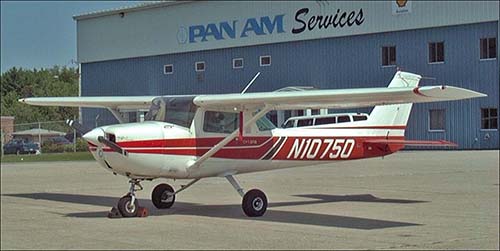
My first Airplane - The Cessna 150 (A.K.A. "Super Flea")
Thursday, March 25, 2004
It strikes me as I day dream about the purchase of my fist airplane, a 1973 Cessna 150L that though it is not my dream plane it is truly for me one of the world’s great airplanes. The lowly little Cessna 150 and its twin sister the Cessna 152 have done so much more for me than any other aircraft type. They certainly are not the airplanes that show up in my dreams but they are the airplanes that most frequently show up in my logbook and in my life.
It is a strange relationship that pilots have with the Cessna 150/152 (C150), I would not be surprised to find that as much as 75% of modern day pilots were taught to fly in the C150 and its line, This humble little ship has proven itself over fifty plus years of service yet like the Rodney Dangerfield of the aircraft world this little ship gets no respect at all.
I find it interesting that as I speak with friends of mine who are pilots who do not yet own an airplane and tell them that I am buying an airplane their initial reaction is one of excitement, “Really? Great! Wish I could own one. What type?”
“Oh, a little Cessna 150,” I reply.
And then it happens, the interest and excitement and even jealousy so previously evident in their face fades away.
“Oh, that’s nice.” They say, not quite looking you in the eye. If I could read their mind I bet I would hear them say, “I thought he said he owned an AIRPLANE. A 150? Don’t waist my time.”
Then right there in front of me with a smile on their face they start to put down my airplane!
“Oh, well when I buy an airplane, I am going to get a Mooney or a Skylane. You know something you can actually DO something with. I mean the 150 is OK I suppose, if you like that kind of thing, but I always found it too small to be practical. It’ll barely seat two people, it climbs like a dog, it’s very uncomfortable and it is much too slow. I mean what can you really do with a 150 anyway? You know what I mean?”
Actually no, I don’t know what you mean. I know what you think you mean, but I also know you do not know of what you speak.
I do know that in five years from now with several hundred more hours in my logbook, and many adventures under my belt spent with my airplane, you will still not have bought your “REAL AIRPLANE.” You will still be renting Cessna 150s on the weekends to stay current, and occasionally renting a “REAL AIRPLANE” for a quick day trip, or you will tag along with a friend in their airplane. I know because I have been there and I have discovered another way.
No a Cessna 150 is not going to impress your friends. It is in no way a SEXY airplane and will not break any speed or time-to-climb records. Still why does the little Cessna 150/152 threaten us pilots so? Why are we afraid to be seen flying one? Why is it that so many pilots feel so uncomfortable with the idea of owning a Cessna 150 or 152?
Could it be that they are afraid that Cessna 150/152 is so synonymous with flight training that everyone who sees them flying one will assume that they must still be a student pilot? I mean why else would someone fly a Cessna 150? Once you have your license you “graduate” to bigger, faster airplanes right? Isn’t that how it works?
Or could it be that we are afraid to admit that maybe we have not yet learned everything there is to know and that this little airplane still has much to teach us after all?
And so as I ponder these questions and wrestle with my own demons over my not owning a “REAL AIRPLANE” I think back over the many gifts that these unassuming little ships have brought me.
It was in a Cessna 152 that I first took controls of an airplane and slipped those surly bonds and it was in that Cessna 152 that my instructor taught me the intricacies of flight. In that little flying schoolhouse I learned of stalls, and of spins. In that tiny classroom I learned of short field and soft field landings. It was in that diminutive little ship that I learned about pilotage, dead reckoning, and electronic navigation. The little Cessna taught me the effects of the wind and of pressure altitude on an airplane. It was in that little 152 that I first wrestled with cross winds and turbulence and in that little 152 that I made my first “greaser.”
It was in a Cessna 150 that I first learned to talk to an airplane and how to listen and understand how it talks to me. It was the Cessna 150 that taught me how an airplane can become an extension of yourself, think “turn left” and she turns left, think “climb” and she climbs, no less instinctive than placing one foot in front of the other. All these lessons and more taught by a patient, forgiving, yet strict tutor made of plastic and aluminum.
It was from a Cessna 152 named N307DW that Steve Brierley, CFI stepped out onto the school parking apron one crisp April morning telling me, “Now give me three full stop landings and I’ll meet you back here.” and with that closed the door on what then appeared to be a huge empty cabin.
It was in that same Cessna 152 that I taxied into position onto the active runway for the fist time alone, for the first time marveled in how quickly the little 152 lifted off the runway and how quickly she climbed to pattern altitude.
I can still remember myself laughing as I turned to express my amazement to my instructor only to find an empty seat beside me. Strange, that after so many hours squeezed into the seats of Cessna 152s with my instructor how completely cavernous that cockpit felt that day. Like the back seat of a Cadillac Elderado it seemed roomy and comfortable. I flew my new best friend around the pattern like a well-practiced pro. Upon my third touch down, words of congratulations from more new friends in the Air Traffic Control Tower. “Welcome home, well Done, PILOT.”
It was in a Cessna 152 that I flew my first solo cross-country flight. One of those milestones of life made all that much more special when I arrived at my destination to find my entire family there to greet me and buy me breakfast at the airport café. It was under the wing of that Cessna 152 that for the first time in my memory, my father; so overcome with pride in seeing his son descend from the sky, on time, alone in that wonderful little flying machine, threw his arms around me and said, “Good Job Son, I am proud of you.” I remember being shocked for these were heart-felt words, with a tear to prove they were true, spoken by a man who normally spoke to his son in much harsher tones. I had previously thought that I was a disappointment to the man, but like so many shattered myths before, it took this little Cessna to show me that it wasn’t true.
Some months later with a fresh pilot’s license in hand, it was in a Cessna 150 that for the first time we flew together. Just father and son, high in the sky on our way to a museum and to see the rocky coast of Maine. Few words were spoken during that flight but my father could not have sat taller in that little Cessna’s seat.

I like many pilots do, moved on to bigger and faster airplanes. I would fly in four seat Cessnas, and high performance singles; I’ve flown nimble little bi-planes that were as comfortable flying up-side-down as they were right-side-up and big lumbering flying boats with supercharged four-hundred seventy- five horse power radial engines mounted on each wing.
So many different airplanes with different personalities, different capabilities and different lessons to teach. I flip through my logbooks and remember them all fondly, cherishing each memory, and loving every single one. Yet peppered hear and there between the entries for the Mooneys, the Grummans, and the Pitts Specials, are the little Cessna 150s and 152s, visiting time and time again like a good old friend.
On one day there is cross wind landing practice, and on another a joy-ride up the coast. On yet another day I see we flew into a little grass strip in Livermore Falls, Maine and took my grandmother and her little dog up to see the town in which she grew-up and raised her kids.
“And look Nana, there is your house,” and “look There…There is the Church where you and Bampa got married.”
And still gazing out the window she replied, “Look at how small it all looks,” and “You would never believe you could fit an entire life from There-to-There.”
And now another first is added to my line of firsts with the little C150. More lessons that the little ship has yet to teach me. The lessons of aircraft ownership, and stewardship.
I find it quite fitting that my first airplane is to be a Cessna 150, a type that has given me more than any other and a teacher with still more wisdom to impart. I have great adventures planned and many more stories to write. My new old friend the Cessna 150 and I have a bright future indeed. I can think of few airplanes deserving of more respect.
To Live, Per Chance to Write...
By way of introduction you can call me Tactic (long story). This is my first post on my first ever Blog. Blog, the idea is an alien one to me. I am not the most net savvy person.
I have lived my entire adult life in the field of Aviation. I have been a pilot for 15 years with time in more than a dozen different aircraft types. I have worked the last thirteen years in the field of Airport Management and have even owned and operated my own privately owned public use airport.
I have worn many hats in my field, Pilot, Airport Manager, Operations Supervisor, Line Crew member, Aviation and Aerial Photographer. And now I have interest in a new hat, that of an Aviation Writer.
I have started a novel, and have written a few short articles for aviation trade publications that nobody has ever heard of.
Recently some people have said my stuff is very good, and this has come as quite a surprise. You see throughout my scholastic career nearly every writing teacher and professor save one, (Thank you Dr. Wellman) had told me that I cannot write.
Being the stubborn type however, the best way to get me to do anything is to tell me that I cannot do it. Still my confidence has been shaken by those "experts" that told me I had no gift for the written word and I rarely finish the writing projects I start for fear that I am not good enough.
As I read the ramblings of those who do get paid to write for aviation periodicals, I have become more and more disappointed with the state of aviation writers today.
I fell in love with aviation at an early age, due in no small part to the writings of Richard Bach, Gordon Baxter, Ernest K. Gann, and the like. Flipping through the usual aviation periodicals today, Flying, Private Pilot, AOPA Pilot, Plane & Pilot, etc. You will find no one of such caliber.
Now I do not profess to be a talent on the level of Bach or Gann. I bring them up because they wrote about aviation in a way that you never hear any more. Lost in the modern day discussion of GPS, and EFB's is the beauty and romance of flight that made us want to be pilots in the first place.
Thirty-five thousand dollars for a new GPS/Satellite Weather/Navigation System you say? - Yeah Right, that's more than my airplane cost!
$300,000.00 for a new Cessna? Come on, I'm a public servant working for a state airport authority. My house didn't cost that much!
All I see in these periodicals are articles about the latest million dollar airplane, or the latest hundred thousand dollar avionics package. Never do I hear of the average Joe who flies his 30 + year old, single engine Cessna on a shoestring budget, for the pure love of flight.
What about Joe's trials? How does he cope with the latest TFR or the rising costs of insurance, aircraft parts and maintenance? What kind of adventures does Joe take with his airplane? A trip to visit the relatives? Rise with the sun for a stack of pancakes at the local EAA breakfast Fly-In? Commute to work high over the clogged interstate highway?
Joe represents about 75-80 percent of the aircraft owners and pilots out there today and yet no one writes to, or about him.
Well Joe, this ones for you.
I have lived my entire adult life in the field of Aviation. I have been a pilot for 15 years with time in more than a dozen different aircraft types. I have worked the last thirteen years in the field of Airport Management and have even owned and operated my own privately owned public use airport.
I have worn many hats in my field, Pilot, Airport Manager, Operations Supervisor, Line Crew member, Aviation and Aerial Photographer. And now I have interest in a new hat, that of an Aviation Writer.
I have started a novel, and have written a few short articles for aviation trade publications that nobody has ever heard of.
Recently some people have said my stuff is very good, and this has come as quite a surprise. You see throughout my scholastic career nearly every writing teacher and professor save one, (Thank you Dr. Wellman) had told me that I cannot write.
Being the stubborn type however, the best way to get me to do anything is to tell me that I cannot do it. Still my confidence has been shaken by those "experts" that told me I had no gift for the written word and I rarely finish the writing projects I start for fear that I am not good enough.
As I read the ramblings of those who do get paid to write for aviation periodicals, I have become more and more disappointed with the state of aviation writers today.
I fell in love with aviation at an early age, due in no small part to the writings of Richard Bach, Gordon Baxter, Ernest K. Gann, and the like. Flipping through the usual aviation periodicals today, Flying, Private Pilot, AOPA Pilot, Plane & Pilot, etc. You will find no one of such caliber.
Now I do not profess to be a talent on the level of Bach or Gann. I bring them up because they wrote about aviation in a way that you never hear any more. Lost in the modern day discussion of GPS, and EFB's is the beauty and romance of flight that made us want to be pilots in the first place.
Thirty-five thousand dollars for a new GPS/Satellite Weather/Navigation System you say? - Yeah Right, that's more than my airplane cost!
$300,000.00 for a new Cessna? Come on, I'm a public servant working for a state airport authority. My house didn't cost that much!
All I see in these periodicals are articles about the latest million dollar airplane, or the latest hundred thousand dollar avionics package. Never do I hear of the average Joe who flies his 30 + year old, single engine Cessna on a shoestring budget, for the pure love of flight.
What about Joe's trials? How does he cope with the latest TFR or the rising costs of insurance, aircraft parts and maintenance? What kind of adventures does Joe take with his airplane? A trip to visit the relatives? Rise with the sun for a stack of pancakes at the local EAA breakfast Fly-In? Commute to work high over the clogged interstate highway?
Joe represents about 75-80 percent of the aircraft owners and pilots out there today and yet no one writes to, or about him.
Well Joe, this ones for you.
Subscribe to:
Posts (Atom)